November 5, 2026 | Podcasts

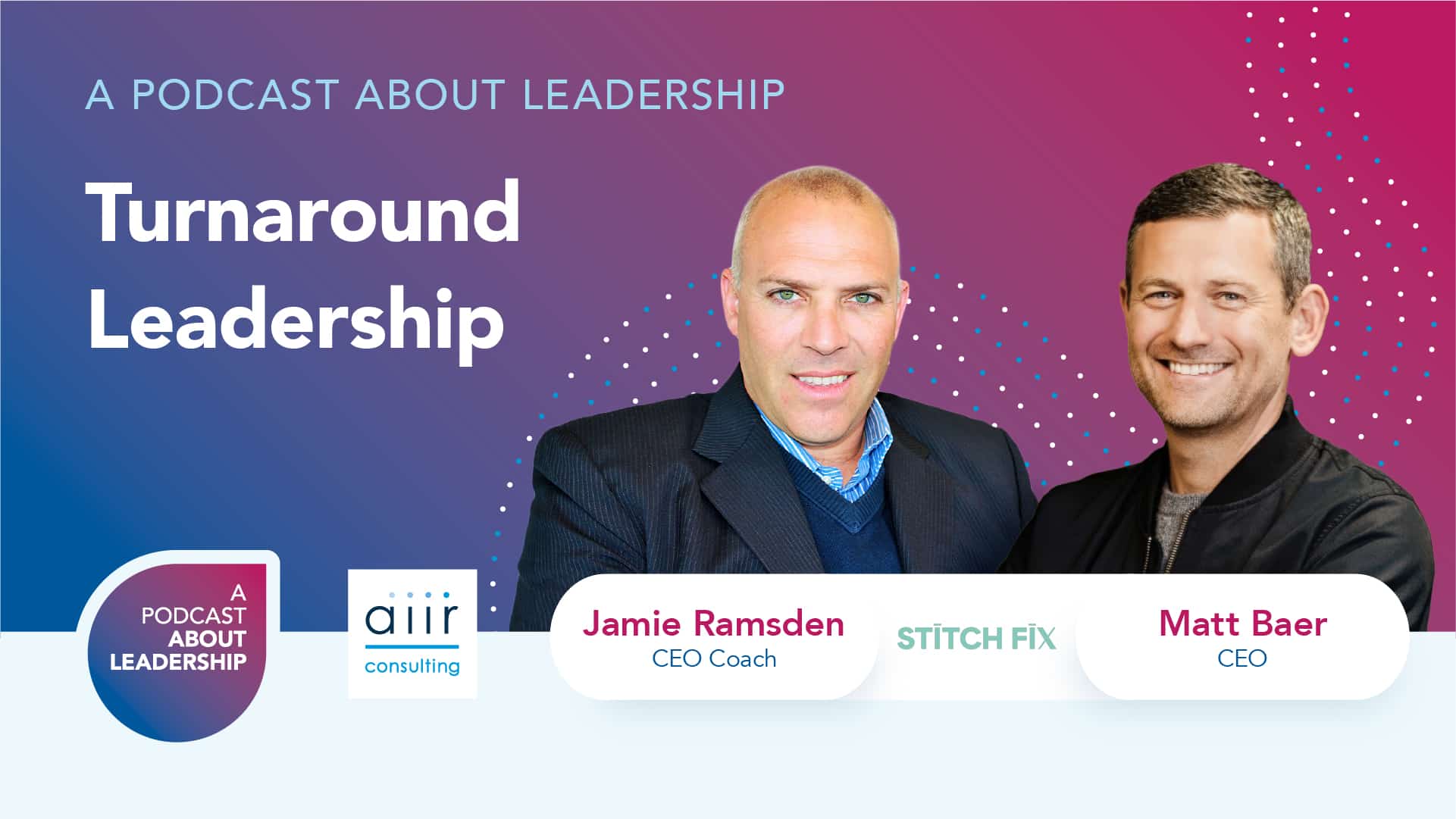
Matt Baer became CEO of Stitch Fix in June 2023, when the company was in a significant decline. Today it has returned to revenue growth and has posted five consecutive quarters of it. On a recent episode of A Podcast About Leadership, Baer joined AIIR Consulting CEO Dr. Jonathan Kirschner and Jamie Ramsden, Baer’s executive coach and a former CEO who led a turnaround of his own. They talked about what turnaround leadership requires day to day.

Start with the Customer

Baer’s first move was to study the customer. He ran a customer focus group while he was still a candidate, and on his first day as CEO his team began setting up in-person client focus groups around the country.

The habit started in his family’s furniture store in Florida, which his great-grandfather opened in 1945. At 16, Baer went from high school to the showroom, changed into a suit and worked as the evening manager. He greeted every client and asked what they were shopping for, what styles they liked and what they could spend.

The focus groups showed Baer that Stitch Fix knows more about each customer before the first order than most retailers learn over years. He saw that data, combined with a human stylist, as the company’s advantage. He also brought a retailer’s view to a company that began as a tech company. Every day in retail has winners and losers, and market share is the score.

Build Trust in Leadership with Your Say-Do Ratio

A say-do ratio measures how often a leader delivers what they said they would. Baer called it central to how he earned trust during the turnaround.

His advice is to move fast, make clear decisions on time and put wins on the board. When you tell your team, board or investors you will do something and then do it, you earn their confidence and their followership. Kirschner described the idea as a way to put a number on trust, and said he plans to tape the phrase to his desk.

Baer added a second piece of advice. You show respect for people’s work by getting involved in it. He gives his teams authority and resources, and he still gets into the details of their work.

Patience Is Concentrated Strength

Early in his tenure, Baer was told that it is always darkest before the dawn. If you trust the direction and can see early signs of progress, results will follow.

Ramsden pointed out that progress in a turnaround moves forward and back. What matters is the overall direction. He quoted Bruce Lee, a line Baer knows well: “Patience is not passive. Patience is concentrated strength.” Leaders need the courage to make decisions early and the courage to stick with them while they play out, even when investors and staff say the plan is not working yet.

To keep his team from burning out, Baer uses an analogy Ramsden gave him. Professional athletes do not play every day like it is the Super Bowl. They also rest, recover and train. Baer applies that idea when he sets budgets, roadmaps and targets.

Hybrid Intelligence at Stitch Fix

Stitch Fix pairs AI with human stylists. Baer described two rules for how the company uses AI. Every use case must be “help and not hype,” meaning it has to improve the experience for a client or an employee. And AI should strengthen the connection between people.

Baer believes personal service was cut from retail over the past 20 to 30 years because companies treated it as a cost. As more daily interactions move to AI, he expects people to value time with another person more. Stitch Fix stylists are often the first to hear that a client is expecting a baby or has a child getting married.

Baer styles clients himself, including one in Letcher, South Dakota, a town of 159 people. The work keeps him close to customers and to the tools his stylists use, which helps him decide what to fix and fund.

What CEO Coaching Adds During a Turnaround

Baer called his executive coaching relationship with Ramsden one of great value. Ramsden is objective and candid and has all the context, so he can either confirm Baer’s instincts or ask what he hasn’t considered. Because Ramsden has been a CEO, his feedback comes from experience. That is why AIIR’s C-suite coaching is delivered by former executives.

The hardest coaching work, Baer said, is finding the balance between patience and impatience. A good CEO is never satisfied, but has to remember how much weight their words carry in the organization.

Ramsden described two balances he watches in any turnaround. One is pushing hard versus celebrating wins. The other is change management, meaning systems, processes and structures, versus change leadership, meaning the people and what they can do. In one of their first conversations after Baer took the job, Ramsden gave him a phrase that stuck: be a benevolent disruptor. Drive the change the company needs while earning the trust of the team.

Episode Transcript

Jonathan: Welcome to A Podcast About Leadership brought to you by AIIR Consulting. I’m your host, Jonathan Kirschner. Each episode, we sit down with leaders and leadership experts to explore what it really takes to lead well. Let’s dive in.

Welcome to A Podcast About Leadership. This is Jonathan Kirschner. I’m your host today, and I have two incredible people on the podcast. Hey, Jamie, who is a who is becoming like a regular is probably confused right now because usually I’m coming in on this podcast with a nice sport coat and a kind of plain vanilla shirt and and here I am. It is summer but this is a this is… If you know my personality there are seashells and palm trees on this shirt. This is atypical uncharacteristic and one might ask you know why am I wearing such a shirt? So here’s the deal. Basically I’m going on a summer vacation. I got some… There’s some fashion demands made on me and I’m like how do I make this happen? I don’t have time to go shopping right now. It’s crazy busy. And then it occurs to me, I’ve got a podcast in three weeks with Matt Baer, CEO of StitchFix. How about I try out the product itself? How about I go on StitchFix? I’m a new customer. I’m a very happy customer. This came from my personal shopper after going through the AI and, you know, sort of like personal information. The fit was incredible. And I’m delighted to have Matt and Jamie on the show today. This is not a podcast where we just like pontificate about leadership abstractly or try to like, you know, infuse leadership theory. This is leadership applied. It’s in the trenches. What is it like to lead whether, you know, we’re trying to scale something, whether we’re trying to maintain something, whether we’re trying to turn something around. Leadership has its various strategic contexts. And today, we’re gonna dig in to a a really, really compelling strategic context at Stitch Fix. And so let me introduce you both and let’s let’s let’s dive right in. So Matt’s the… As I mentioned, the CEO. And and StitchFix is a is a leading… It… I… To me, it’s like the best, personal styling service. It’s leveraging incredible insights and knowledge about its customer, and it’s doing that through a combination of human and AI, is just, like, incredible that everybody who listens to me knows I love hybrid intelligence. So it’s really, really an incredible example of that. And, Matt Matt became CEO in June 2023. The company was actually in in a bit of a dip, if you will, and he has been very, very focused on leading a transformation that has now returned the business to growth. So that is just awesome. It’s funny, like, you could talk about that as like a business school professor or a case study. I happen to be a CEO. Jamie happens to be a CEO. We know what that actually feels like. So congratulations to you, Matt. And I know transformation, you know, it has a beginning. I I don’t know if it has an end. It’ll be great to to talk and and hear about your perspective on that, but you’re certainly on the journey. And Matt came to StitchFix from Macy’s, where he’s chief customer officer and digital officer, leading the digital strategy for Macy’s and Bloomingdale’s, while driving initiatives focused on deepening customer relationships. And then prior to that, he was VP of ecommerce at Walmart and played a key role in their transformation of the digital business. So clearly, retail is, is in Matt’s DNA and actually growing up, you you actually worked in your family business which was a furniture business. So so really, really in the DNA there. Jamie, he is our CEO coach extraordinaire and, author of one of my favorite books, Let’s Go! Jamie himself has led a turnaround and a transformation as as CEO of an automotive parts company and and and is actually Matt’s coach. So it’ll be great to actually learn more about how that’s going. Matt, I mean, as I mentioned, you you kind of just like grew up in in retail. You’re sort of born into it and the family’s furniture store in Florida. Family business started by your great grandfather. Yeah?

Matt: Yeah. Great grandfather, 1945.

Jonathan: Unbelievable. That’s

Matt: Yeah.

Jonathan: That’s incredible. That’s really incredible. So I just… My first question to you is, know, up in that world, what did you learn, you know, from from seeing your, you know, your your your family and and and from being in the store and connecting with customers. What did you learn about leadership, and what did you learn about the customer?

Matt: Yeah. I I appreciate you starting there. I I love talking about that and the unique opportunity I had growing up immersed in a family retail business. But, also, I just wanna appreciate the opportunity to be on here today, and I appreciate the really kind introduction as well as the fact that you’re now a StitchFix client and, did a phenomenal job selling the exceptional service that we can provide everyone. And I’ll also vouch that that Jamie is is definitively an extraordinary coach and and feel lucky to have that relationship with him and excited for the conversation today. But… Look. Growing up in a retail family business, you learn so many things, and it it probably wasn’t… Or definitively wasn’t until I was much older that I recognized just how lucky I was to have had that experience. And reflecting back on it, there are several things that that come to mind that would have impacted, you know, how I think about leadership and how I think about the customer experience overall. When I was 16 years old, I used to go from high school to the local showroom, and I would have to, like, code shift both mentally as well as, you know, change into a suit and walk into the showroom and and was, you know, in many ways, the the evening manager of that showroom. And it felt like second nature growing up in a family business. That might just be something that everyone does. But the idea of being a 16 year old in the showroom working with clients one on one and and having a full staff of employees both front of house and back office, you learn a lot. One thing that you learn is the importance of brand. When the family name is on the door, you understand just how cherished a a brand is and how important it is for you to show up every day in terms of how you build your relationships with clients, how you treat your employees, and, ultimately, how you’re known, within your community. And that, you know, has definitively stuck with me, throughout my career. Another important learning is just when you’re on the Sales Floor and a client walks in the door, you greet them. You know? Hey. Welcome to Baer’s Furniture. You know? I’m Matt Baer. How can I help you? And you start asking questions to get to know them better. You know? Why are they why are they in the store today? What styles do they like? You know? What rooms are they shopping for? You know? You try to ask around questions to understand what their budget might be. And all of that information becomes so critical so that you can give that individual client, the absolute best level of service. You know, that’s one of the many reasons why I I was so excited about, the opportunity that I have now at StitchFix. From a leadership perspective and how you work with the team, not too dissimilar from how you wanna get to know every client one to one. With employees and team members, you really wanna meet them where they are, get to know them individually. What are their motivators? You know, what brings them to work? What will get them excited about their responsibilities? How to set them up for success? And that’s always been a focus of mine, and I I I try to, you know, put my best effort there to create unique experiences for each individual within my team, to maximize their potential, to drive their engagement, and and to best ensure, their their happiness at the end of the day. And then maybe the the final thing that that I’d share too, and you really just have to trust your instincts. You have to be confident in yourself. You have to have clarity in your communication, and you wanna have consistency in your leadership. And, you know, when you do that, you’re often gonna get the best results out out of your team at the end of the day.

Jonathan: I love that. Jamie, you grew up in a family of musicians. What did that teach you about leadership?

Jamie: Well, I think… I’ll be very brief here, but, like, I think growing up with the… With musician parents, it it gave us access to lots of people. Like, we covered the whole social. Right? So we had artists and creative people. And then my parents also worked with and for, you know, business people, and we’d… So we’d be dialed into the community, and we’d see, like, all of the adults. So as a kid, I got to see, like, I think what what I’d call, like, the common humanity amongst people. There’s a role that you play. There are preferences and predispositions that you have. But what we were able to see is that people love to be connected. They love to have fun. They love social interaction in general, introverts or extroverts. But just like that binding, that common humanity that brings us together, which is ultimately the essence of leadership. It’s about, you know, unlocking, understanding people’s motivations as as Matt just said, understanding what they’re looking for, satisfying their needs. A fulfilling life includes that, whether it’s with your family or your friends, your spouse, you know, or or your workplace. It’s about understanding people’s needs and being able to serve those.

Jonathan: Now fun fact, Jamie. What… Your your parents’ band, they had a a a top 10 hit, no, in The UK

Jamie: That is correct.

Jonathan: Back in the day.

Jamie: They had a top 10 hit here in 1965. It seems like a lifetime ago, which it was, with a with a Beatles song, and they actually recorded it with the Beacons. That’s their claim to fame. There’s no other band that actually got in the studio with John, Paul, and George. Ringo wasn’t there. No.

Jonathan: That’s so…

Jamie: That was a top 10 hit in The States.

Jonathan: That’s very cool. Not everybody can say that. Okay. Matt, back to you. We’re we’re going back to 2023. You start your first day of work as CEO of StitchFix. Company is in a pretty significant decline. Okay? Help us understand what were those first few months like, you know, what did it feel like? What do you see? And and what were your first sort of moves as CEO in those first few months?

Matt: So I was so excited about the opportunity to join Stitch Fix. It was a business that I had observed from afar with a tremendous amount of respect, tremendous amount of, like, intellectual curiosity. My career in many ways had been in the pursuit of the confluence of retail and technology and then how we can use innovation to better serve clients. And at the core, that’s the mission of StitchFix. And the opportunity to join the team and and to lead the company was very exciting. The founder, Katrina Lake, again, you know, someone that was very inspiring in terms of, you know, what she had accomplished, what she had built, and confidence and the trust that she placed in me to realize… Fully realize that that original mission and vision of the company was, you know, not something I I I took for granted. And when I joined the company, one of the things that jumped out to me right away was just how smart and how passionate the team was. This was a brilliant group of folks that really did believe in the mission of the business and were very passionate about finding how to unlock that. And the first thing I had to do was to learn as much as I could about the business where it was and learn as much as I could about the customer. I actually created a a a customer focus group when I was a candidate to get an even better sense. And on day one as CEO, I met with the team, and we started to stand up in person client focus groups around the country that really helped shape my understanding of the opportunity and where the business was. And it became really clear to me that we just had tremendous assets. And if we put the right system in place, we would be able to unlock those. And those insights were that we knew more about each customer before their very first transaction than any other retailer eventually knows over the lifetime of their relationship. And that information, that data is the holy grail for a retailer. And then our ability to both personalize the experience one to one to each client and to layer on the empathy, the nuance, and the expertise of a human stylist becomes a level of service that’s unparalleled. You can’t get that anywhere else. But we also had work to do across the board, and that was both structural and cultural. From a cultural perspective, something that’s always stuck with me that I that I really appreciate is that retail is a competitive sport. Every day in retail, there are winners and there are losers. And in many ways, that scoreboard is your market share. But, you know, we need to get that culture embedded within the organization that we had to fight every day to serve our clients such that our clients made sure that when they had a desire and intent to purchase, they were coming to us and not anywhere else. And that’s been a bedrock of our transformation. In terms of more of the structure and the systems of how we operate, we had a lot of work to do to strengthen the foundation of our business. And I just have this really strong belief that you can only build a strong, enduring, profitable company if the foundation is strong. And we got to work examining every function of the organization and determining what would be required to have a really strong foundation. And then once that foundation is strong, what is the work that would be required to reimagine it such that we could evolve the business to meet the client where they were today or, you know, in 2023 and into the future? All of those insights, all of that work led to a pretty formal transformation strategy in three phases. First, to rationalize the business, then to build the business back, and ultimately return that business to growth. And we we got to work in the fall of twenty three putting that strategy in place and executing against it. And here we are now almost three years later and just really proud of everything that the team did and trust and confidence they placed in me and each other. And, you know, I… You you you mentioned earlier, you know, is it transformation complete? I have a fundamental belief that, especially in retail, cost… Companies that find success find themselves in a perpetual state of transformation. There’s never a a flag planting moment. If you think you’re done and and you’re ready to put it into cruise control, someone’s gonna come take that wallet share right from you.

Jonathan: That’s like the beginning of the end. Right? You become like a a day two company or…

Matt: Right. That’s right. That’s right. So while we’ve achieved many of the objectives of the transformation that we put in place in the fall of twenty three, we’re right back, you know, challenging ourselves anew. How can we transform our business further? How can we serve our clients even better? And how do we, you know, continue to ensure that, you know, we are that retailer that our clients are choosing for any and all of their apparel, accessories, and footwear needs?

Ad: Quick break to tell you about AIIR executive coaching. Leadership is a tough job, and today’s leaders face more complexity and change than ever. Just like an elite athlete would never play a sport without a coach, successful leaders benefit immensely from having an expert leadership coach. At AIIR, we have over 200 leadership experts around the world who are trained to deliver exceptional coaching using our proven AIIR methodology. AIIR executive coaching helps leaders unlock their potential, increase their leadership effectiveness, and drive organizational impact. If you’re ready to take your leadership to the next level, visit us at aiirconsulting.com, and let’s get started.

Jonathan: Wow. I… Sometimes I think of leadership as, like a game of chess, and we’re just making these moves on the board. And, you know, if we were to use that metaphor, clearly, even before day one, like day zero, you know, your first move was to understand deeply the customer experience Which was… And there’s so many places you could go. I mean, you could go to supply chain, to tech, you… To to cost cutting, to to, you know, talent. There’s so many different places you can go on day one, and it’s just really awesome to hear that like where you went was was directly to the customer. But you said something about, you know, in retail and and we… You know, I I have the the privilege of working with, a number of retailers and and retail executives and it is a fight every day. It is a fight every day. And you could be you could be like winning And then the moment you you you know, take your eye off the ball, you know, you’re you’re you’re on the bottom of the scoreboard. And it’s like… So so it sounds like you helped the team really under… Like somehow adopt that play to win mindset that every day is a fight. How is it… So if you can say more about that and specifically like… Because it… It’s it’s awesome, but it also sounds like exhausting. Like, how do you how do you do that practically? And and and, like, how do you offset the exhaustion and…

Part 2: Culture, Advice, AI and Styling Clients

Matt: There there are a few ways that you do that. So I think I think first in terms of how you build that into the the fabric of the company, you know, it takes time. There… There’s a bit of education. There’s a bit of learning through experience and the sharing of examples. And in many ways, Stitch Fix was, you know, appropriately born more as a technology company than a retailer. And a lot of those retail basics and fundamentals and the culture that make retailers successful were new for many folks. And we spent a lot of time having those discussions both with leadership and at all hands. And I I think people, you know, really started to embrace it, started to understand it, and especially when you’re able to paint that picture from the lens of a client or a customer. And how are they experiencing your product, how are they experiencing your service, and wanting to make sure that what we were doing was superior to anything they could experience anywhere else. And that’s true from every interaction with our our digital platforms to every interaction with our stylist to every single time an item of physical apparel ends up in a in a a client’s home. We want them to have the absolute best possible experience and manifestation of our brand. And that becomes, many ways, the barometer of of success. And you focus on those inputs, and over time, the the outputs, you know, the financials, the sales will manifest. And, you know, there was a lot of work that got us back to that return to growth, but those, like, green shoots and those wins along the way became more and more evident. And I do believe in human nature, people wanna win. People wanna deliver, you know, great impact with their work. And celebrating those and recognizing those was really important for us. You asked another important question, though, around, you know, how do you ensure that that you don’t get exhausted? And, you know, I think that, like most things in life, you have to find balance both at an individual level, a team level, an enterprise level, and you have to be as mindful as possible in terms of how hard you would push for a short term gain versus maintaining the energy and the resources for long term results. And, you know, in… Often and in many ways, that’s one of my core responsibilities, both for myself as well as the team and the company. And, you know, we throttle that all the time and and hope to get it right and hope to do it appropriately. And it… It’s something that that I’m mindful of. And and Jamie, you know, shared with me at one point an analogy of a professional athlete. And you don’t show up every day putting forth the effort that you would necessarily if you were in the Super Bowl. You also have to have periods of rest and recovery and conditioning and training. And that analogy is always in the back of my head when thinking about, you know, how to build our road maps, how to set our budget, how to challenge our teams, and and how to ultimately get to the long term results that we’re striving to achieve.

Jonathan: What’s the best advice you got, you know, during this this turnaround period?

Matt: You know, I think I think probably the the best advice ultimately is to trust myself and my instincts and and kind of what what got me to this place. And that manifests in many different ways. But one of them would be you need to move fast. You need to be decisive. It is much easier for a team to execute when the vision is clear, the direction is clear, decisions are made on on a timely basis with clarity, that it’s important to put wins on the board. And in in many ways, it’s important to put wins on the board because you want to be known for success with your say-do ratio. So if you go out to the the team or the board or the investor community and you say, I’m going to do x, and you deliver that, you start to, earn trust and earn confidence and and earn followership followership, along the way. And then, you know, the other piece that I think was really important advice that I got too is that you show respect for the individual or the team or the work by involving yourself in it. Empowerment is really important. Properly resourcing individuals and teams is really important. But I think you have to be careful to understand the nuance in that. That that doesn’t mean that you’re not also involved, that you’re not respecting that work by showing interest, by adding value where you can, and showing up to to take that interest. And that’s something that, you know, I… It it probably comes natural to me, but I like to be involved in the work. And that was, you know, another really important piece of advice that I got that that basically validated that that perspective and that it was okay to to to really get into the weeds and to understand the work that everyone was doing, you know, throughout this transformation. And maybe the last piece I’d I’d share too is, that was, you know, pretty important advice, particularly earlier on in my tenure is that, it’s always darkest before the dawn. And, if you just have confidence in terms of where you’re driving the organization and the work the team is doing and the, you know, the green shoots that you are seeing, the dawn is coming. And it was also, you know, to be fair, really nice as we did, know, officially return, to revenue growth, about a year and a half ago. So, anyhow, those are the things that kinda come to mind that were really instrumental, you know, when I joined in in terms of the advice that I received.

Jonathan: It’s always darkest before the dawn. I think that’s an incredibly important just reality factor. And… Because in turnaround, you’re just like, yeah. Turn it around. Like, turn it around. You know? It’s like, of course, it should happen, like, real quick. And it doesn’t always go on the timetable we want it. Right? It’s really, really hard. The other thing that really is my

Matt: You know, on that on that piece though, which I think is important to note as well is it’s important to… For that timeline, that timetable to be one that a lot… Enables that enduring growth. And sometimes you can return, you know, get things done on a on a faster timeline, But will that set you up for long term success, or are those shortcuts, you know, precursors for future failure? And, you know, for us, we wanted to get it right. We wanted to take the time to do it right, to build that strong foundation. And, you know, it… It’s… You have to find that right balance of patience in there as well.

Jonathan: Nice. I also really love the say do ratio concept. I have never heard of that concept. I think that is absolutely brilliant because that is ultimately, like, what… Because you’re, like, quantifying trust essentially. Right? The say do and what… Whatever that gap is, then if it crosses a certain threshold, then then trust isn’t adequate or sufficient enough. That’s actually like a brilliant brilliant concept. Do you actually track your say do ratio?

Matt: Not not formally, but, know, ex… Externally, you you can, especially as a public company. And, you know, but in in… Internally, you know, in… At the highest level, when we put this transformation strategy into place and, you know, phase three, a return to growth and, you know, where we were from a starting point perspective, you know, we… And and the milestones along the way, I think I think I think you’re absolutely being tracked even if I’m not tracking myself.

Jonathan: Nice. On my on my desk at work, I have my strategic development plan because like I’m always

Matt: Okay.

Jonathan: In a coaching relationship and since I’ve started there for the most part, I have my my three goals and I tape it on there. I’m gonna put a post it note or some note that says say do ratio right above that because this is I’m gonna marinate on this one. Could we… Let’s let’s shift into AI for

Matt: Okay.

Jonathan: For a moment because I know that’s really integral to the strategy and and the the product at Stitch Fix. And, help us understand, like, how do you think about AI and human judgment? You know, what I termed earlier sort of hybrid intelligence. How are you thinking about that? And how do you ensure, like, that the human experience… I mean, you said you said you said, like like, customers need to feel welcome and greeted. Right? How do you make sure that customer experience and and and the human experience isn’t lost?

Matt: It’s a great question. It… It’s something that we’re focused on daily at Stitch Fix. We have an innovative culture, a disruptive mindset. It… It’s in our DNA. And we are utilizing AI internally to really challenge how each individual works, how each team functions, how the business operates overall. We also have leaned in and and have leaking client facing AI capabilities as well. When we’re thinking about this internally, though, there’s a couple of elements of our philosophy that I think are really important. One is a filter that we have is that our utilization of AI is about help and not hype. Every AI use case has to be in service of delivering a better client or employee experience. And the second is that our utilization of AI is to improve and empower that human connection, not to fundamentally replace it. So when we’re building AI driven tools for our stylist to use when they’re working with a client, it’s so that that human stylist can provide an even better experience for the client. Or when we’re creating client facing AI experiences, they can then leverage those tools and those experiences to deepen their relationship with stylists to better understand their needs and intent when it comes to apparel shopping. And the reason why I believe that is so important is because I just fundamentally believe in the value of human connection and the level of service that people want and that they had been used to for generations, for, really, for all of time. And I think in a pretty, you know, unfortunate or sad reflection on retail, that was looked at as a cost center. And over the last twenty or thirty years, has been effectively costed out of businesses, And it’s harder and harder to get genuine service from someone that knows you, understands you, knows the communities that you’re in, knows your budget, knows what’s in your closet, knows, you know, probably what event you have coming up in your life that that brings you into the store. And as more and more of our daily interactions are being replaced with AI, the most on demand thing, the highest value thing is going to be opportunities to connect with another human being. And the Stitch Fix business model is uniquely positioned to capitalize on that. We provide that one to one connection. Our stylists are often the first to find out if someone’s expecting or if their child’s getting married or they have a a cruise coming up. And and, you know, that is really awesome and gives us this competitive advantage, and and we’re gonna continue to lean into that. So we don’t we don’t see them as being, like, binary choices. We see them as being in service of each other. And, you know, that that… That’s how we are focused at Stitch Fix.

Jonathan: In service to each other, but also in some way, your your way you’ve architected it and the way you’re thinking about it, the AI is is there to sort of like enhance the human connection and human experience.

Matt: A 100%. That’s exactly right.

Jonathan: Which is incredible. And and honestly, like, I’ve I’ve been in… My mom used to get, she’s taking me shopping. She’s a big shopper. And we go to the mall. She would get, like, birthday cards from, you know, whether it was, like, you know, Saks or or or Neiman’s, you know, would get, you know, cards in the mail from From the the merchant. And it was just… It was a beautiful… And and now, you know, you go into, you know, you call it, retail desert. Is that is that the terminology? You know? So I I might be botching this, but, you know, sometimes you go into a mall these days or you go into a department store, and if somebody’s on their phone and and they’re… You’re like, is there anybody here? Like, hello? Anybody? Like, do you guys even want me to buy something? Like, do you even… And it’s it’s super depressing. So, anyhow, just just, you know, reflect

Matt: As someone that’s, you know, obsessed with and passionate about retail, it it can be sad. And and you definitely… Clearly, you’ve done your homework. We… The the… What we talk about internally is is fashion desert.

Jonathan: Fashion desert. Sorry. Not not retail desert.

Matt: And with more and more malls closing, more and more department stores closing, more and more of this country doesn’t have access to the assortment, you know, you know, even if… You know? And and even those that do don’t have access to service. And at Stitch Fix, we’re uniquely able to solve that. We are able to bring the best multi brand apparel experience to customers wherever they live and couple that with a level of service that’s better than they can get anywhere else. And, you know, it… It’s so fun seeing it come to life. And and so so I’m a stylist for many clients. And one of my clients, she lives in Letcher, South Dakota, population 159.

Jonathan: Wow.

Matt: She does not have the ability, you know, to go out and go shopping for apparel and have access to the brands that we sell or have access to the level of service that we provide. And I just get, you know, such joy, you know, working with her. And I actually I actually just styled for one of my clients. He lives in the UP or the Upper Peninsula in Michigan right on Lake Superior. He… He’s hours away from from the, you know, the closest location where he might, you know, be able to access some of these brands, but it’s it’s great, you know, being able to to to serve him and and it it it makes the job really fun.

Jonathan: That’s amazing. I love that you actually do the work itself, that you’re actually a stylist. I think that is like like, what better way… And I’m sure it’s like fun and cool and it’s a nice break from all the CEO stuff, but but it also… Like, what better way to understand the customer and your product. Right? And so that’s really amazing.

Matt: Yeah. A 100 a 100%. It’s it allows me to get, you know, close to my… Close to the customers, close to the clients on a daily basis. Really, you know, hearing from them directly and serving them individually is is invaluable insights. Our stylist community, they’re they’re phenomenal. And the ability to get into the tools and systems that they’re using on a daily basis, understand the experiences that they’re having helps me make better business decisions and have better judgment in terms of what we prioritize and what we put on the road map to making sure that they are always set up for success. And then also just the familiarity with the tools and systems and our physical assortment, it… It’s… It allows me to understand them intimately as well such that, you know, when we are thinking about, you know, the the quality of our tools and systems and where to invest and thinking about the the quality and breadth and depth of our assortment and the brands that we carry, that that firsthand experience and knowledge it is really invaluable. And we we we actually encourage all of our corporate employees to style clients. We don’t require it because it is it is… At least for me, I could tell you personally, it took a lot of confidence to build up to the very first time. And, you know, but but once you once you do and you start to get familiar with it and more confident in it and find your groove, it’s one of the most rewarding things, that that we get to do each day.

Jonathan: So cool. I absolutely love that. I absolutely love that. So I… We we got Jamie, you know, on on the call today, and and he’s your coach. You’re… You… You know, since 2023, I you… You’re leading this this transformation. And, you know, a turnaround is hard. It’s also kinda lonely. Right? So, you know,

Matt: It how can be. It can It can be.

Jonathan: Right. It’s maybe your choice. Right? And… But, you know, how how has coaching sort of helped you and added value within that broader context?

Matt: For for me, it’s a really unique relationship, that just has immense value. It is someone that has the right balance of objectivity while also having the full confidence that, you know, just full candor and, you know, can help be that, like, confidant to bring someone in to the most important decisions that that you have to make, the most challenging situations that you might be in. And and, know, depending on where the conversation goes, it can either be validating in terms of, you know, you are on the right path, that, you know, you… You’ve got the right instincts, or, you know, it’s someone that you respect and has all the context that, you know, they can challenge you and say, well, know, you have you ever thought about this, or have you tried that? And it’s just immensely valuable. And then, you know, the fact that, you know, Jamie’s been in this seat before, it’s it’s great to hear, you know, those stories from that lens and and know that the the feedback or the conversations that you’re having are with that that same, like like, context of having lived the experience previously. And, you know, that… That’s just, like, you know, something that I think, you know, shouldn’t be overlooked in in terms of just, you know, how important that relationship is. But, you know, we’ve, you know, been through a lot over the years and and and has helped me immensely through, you know, many of the most important, moments and decisions, that I’ve had to make.

Part 3: Coaching, Jamie’s View and Closing Advice

Jonathan: Nice. Where does he push you the the hardest? Or where where… You know, you said he… You know, it’s it’s a com… This, like, delicate combination of, like, support and challenge. You know? Where is he?

Matt: Probably probably

Jonathan: Where is he the thorn in your side?

Matt: The hardest, but but maybe I’ll share where where he’s probably had the least successes. He’s always trying to get me to to exercise. And, and here we are. I don’t… I haven’t, you know, truly exercised one day, since since we… Since we’ve met. But, you know, but maybe maybe today’s the day.

Jonathan: Stay out of Jamie.

Matt: You know, I think I think in serious… I think in seriousness there, I think probably it’s, like, finding that right level or balance between patience and impatience. And, you know, with that knowledge that transformations and success, they’re they’re they’re not linear. And that while a good CEO is perpetually dissatisfied, you have to also be cognizant in terms of how you’re showing up and how you’re leading the organization and and the weight that your words and your actions and your, know, your your strategy can can can lend itself to the organization. So, you know, I think that’s, you know, probably the pay… The place where, you know, there’s… I don’t know if it… I don’t know if he’s pushing me necessarily, but by, you know, giving me the most, like, constructive feedback in terms of making sure we’ve got that balance in check.

Jonathan: Nice. I I love that the CEO is perpetually disappointed or or or always sees, like, where we could be better. I I learned about that concept in my… When I, did my first three three sixty assessment, 360 degree assessment. Okay. And I was like, oh, this is gonna be awesome. Like, everybody’s gonna say nice things about me. And, you know, it’s like comment after a comment. It’s like, you know, he just… It’s never enough. It’s never enough. You know? He says, like, alright. What’s next? When we… And it… I’m like, okay. Okay. Okay. How do we how do we balance this out a little bit?

Ad: Great leadership teams don’t happen by accident. AIIR team coaching helps leadership teams by closing the gap between where they are and where they need to be, building trust, sharpening execution, and driving results that everyone in the organization can feel. Ready to take your team to the next level? Visit us at aiirconsulting.com, and let’s get started.

Jonathan: Jamie, what’s it like on your side of the table? And, you know, in in Let’s Go, you talk about, you know, four different sort of leadership roles, role model, community builder, sense maker, future shaper. We’ve talked about that on the show. Curious, you know, where you see Matt, you know, on that paradigm. And and then just in general, like, how has it been coaching Matt?

Jamie: Yeah. I think, you know

Jonathan: The highlight the highlight of his career.

Jamie: I’ll start with the easy one. I think it says that the the model… You know, the the fortunate thing is that Matt and I had worked together before we got to Stitch Fix, so we already had a basis of understanding. And so, you know, when you’re in a turnaround, there is this balance, this competing pressure between, how do I push hard and how do I celebrate the wins? So it’s that… On that dimension. And then what is change management, which is about systems, processes, and structures, and what’s change leadership, which is about the people in the team and unlocking potential in the team. So we’re sort of constantly, you know, sort of balancing and seeing where we are there. Because we’d work together, one of the things I was really confident in is that, you know, and the do ratio is a really good example, but we wouldn’t have to worry about Matt’s consistency or integrity as perceived by the team. It’s really important to him, say do ratio. And so I was like, okay, we don’t need to focus on, like, being credible and authentic and having integrity to the team. At the same time too, given where the organization was, the idea of sort of having this beautiful north star that we can align towards, I was like, well, we have to sequence into that, first of all. So really, the areas that we focused on were around, you know, community building. So in in in the early stages, I think it was being sort of direct and clear around communications and what the expectations were. And then also sort of sense making, as we talk in sense making role, is creating a sense of urgency around, execution. And so those were two of the, you know, the first things that we did in sort of building out the foundation. Now there’s a position where we can talk a little bit more about what does a normal start look like. We’ve got some wins on the board. There’s some momentum behind the organization. And so that was really the focus. There’s sort of as much about galvanizing this group of people, making sure we have the right people in the right spots, and then, you know, allowing them to bring their expertise as we build out the organization and get some momentum into it, which is demonstrated by, you know, five quarters of con… Consecutive growth. The other thing I think that’s in there, and and Matt alluded to earlier on, like, having been through a transformation myself, nothing of this order of magnitude, but just the sequencing, is this piece around success is not linear. And so those dark mornings, actually, it’s not just one and then there’s sunlight. It’s actually, you can have one and then go back. It’s… It it does this. Remix like life. There’s cycles around it. It’s the trajectory that’s important, and I think that’s where I could have been helpless to say, okay. We sit on the right track because days might go up or down. We might make progress here, then we take a step back. But is the trajectory heading in the right direction? And there’s a phrase that, you know, Matt will be familiar with. He might even finish it for me, which is is that patience is not passive. Patience is concentrated strength. That’s from Bruce Lee. And so once you have a light… Once you’ve got yourself comfortable and you have the right people in place, that’s part of the tendency then is to say, okay. Where am I recognizing effort? Where am I… And I talked about this, I think, on our last call. It’s the courage to make the decisions earlier on, but also the courage to to sit with the decisions that have been made that are unfolding in real time. And that, you know, in any transformation, that requires judgment. It’s not something you’ll ever read in a book. It really is sort of listening to the world around you, trusting your own instincts, and then deciding. When do I have to… I’ve set the system in place. We’ve got momentum, and, actually, I might need to just step away from it a little bit and just let it play out. Even if people are coming to me and saying, hey. This isn’t working the way we said it would, or we’re not there yet, or even if there are investors or very important stakeholders saying, you’re not there yet. That’s where the courage is, and that’s where it can be a little bit isolating. Where you’re like, no, I’m on the right path, we’re on the right path, I had the right group, we’ve done the work. We cannot skip a step. We’re going to work through this thing sequentially and, you know, as Matt said today, he’s like, he’s seen the results of that. But it is a lot of work at the front end.

Jonathan: Patience is not passive. Patience is not passive. That is profound.

Jamie: It is concentrated strength.

Jonathan: It’s concentrated. And and so Bruce Lee, like the world’s, I guess, best martial artist ever, he’s the one who coined that. It’s incredible actually because I I I always tell people like patience is my my my Achilles heel. And and, actually, if you relate to patience as a passive inevitability, that you have to somehow, you know, just embrace sometimes, then then, yeah. I mean, maybe you always relate to it as a as a bad thing. And yet here, it it can be a strength, to the extent that we view it in this light. I love that. I know we’re sort of getting towards the, you know, the end of the hour, and I just have, you know, two questions for you, Matt. You know, first

Matt: Okay.

Jonathan: Is, you know, your great grandfather, you know, he started Baer Furniture in 1945. You you know, we we we acknowledge at the outset of this podcast like you’ve got retail in your DNA. What would he say to you right now? I mean, you’re leading one of the most innovative, retail organizations in the world. What would he say to you today?

Matt: It’s a good question. First, I think he would ask why I’m not working for the family business. Why are not selling couches? And and and, you know, once we got past that, you know, potentially awkward conversation, I think I think you would just be proud. I think that’s what family wants for future generations is is for, you know, folks to go out and find what they’re looking for in the world. That something from a professional pursuit that challenges them, that they love what they do, that excites them every day. I’ve definitely found that at Stitch Fix. It it meets, you know, everything that I’ve always looked for in an opportunity. And I think you would just be, you know, really proud of me, really excited that that I was able to to to, you know, find find that place.

Jonathan: We’ve covered a lot of ground today. We’ve talked about leadership broadly, but we’ve also been kind of focused on the specific strategic context of a turnaround and what’s required to transform and and and be successful in that context. And, Jamie, I ask you the same question as well. But, Matt, you know, having gone through this, you know, what’s one piece of leadership advice that you would give to someone who is just handed? Right? Think about that day on… In in in 2023. Somebody who’s just handed a turnaround situation. What advice would you give?

Matt: Yeah. I’d I’d go back to something that we talked about before. For someone that’s going into a role, first time CEO, believe in yourself. Have that confidence in yourself and in terms of what got you there is, you know, what’s going to be required in order for you to be successful. Actually, in one of the first conversations that Jamie and I had after I got the role, he he introduced me to a term benevolent disruptor. And that actually, you know, I think meant a lot to me individually because I recognize we… We’re going to have to have a lot of transformative change, to ultimately find success. But how do you show up, you know, as your authentic self? How do you show up in a manner in which you can work to earn the respect and trust and confidence of the team? And, you know, that goes back to to putting wins on the board and and having a a a strong say-do ratio, meeting your employees where they are. But at the end of the day, you’ve gotta trust your instincts and clearly communicate the strategy and the direction of the company, and then execute at a high level. And none of that means that it’s it’s going to be easy, but I think that, like, that consistency and that constant confidence and belief in in your own abilities, it it it will only be harder if that waivers and, you know, the very… You know, much less likely to find success if you allow that to to to kinda disappear. So, you know, maintain that confidence, maintain that same sense of self that got you into that role initially.

Jonathan: So easy to lose sight of that, especially… I mean, you’re a publicly traded company. You got analysts get… Weighing in. You have every… You have opinions coming in from everywhere. It would be so easy to be, like, tilted, you know, and to lose confidence, especially on those days where it doesn’t go… It doesn’t work out the way you you wanted it to. But to really stay grounded in in your own conviction

Matt: Yes.

Jonathan: And and to believe in yourself is like… It sounds silly and cliche, but it… Oh my god. That is like extremely extremely important. So thank you, Matt.

Jamie: I would probably say don’t do what I did. At least in one area, which is, you know, I went to our clients and said, when we were the worst supplier in the industry, and I said, we’re going to be one of the best suppliers in the industry, which was a challenge that I’d accepted for myself. But in declaring it, I guess I made it real, but it did put a lot of pressure on me.

Jonathan: What did that do to your save you ratio, Jamie?

Jamie: Yeah. Well, we got there. I mean, we got there. So, but I think, you know, I should have internal… Or could have internalized that and said, hey. Listen, folks. We’re gonna be one of the best suppliers. Let’s go and show them. But but I think, you know, there’s a couple of things. I think one is building on what Matt said. It’s the courage. Like, you… You’ve got here, believe in yourself and have the courage of your convictions. And when you set in place in motion the things that you know are gonna yield success, it’s the courage to say, it’s going to happen. Because it it… There is a gap. There is a gap between when we do the work, and there’s a gap internally when we can see the difference that’s been made. And when the external world can see it, there is this lag. And if you anticipate or if you intervene at the… In those moments, you can actually create the worst conditions, like you… You know, rather than just having the courage of your convictions. Number two would be have people around you who can help give you a sense of balance and perspective that can reenergize you. Because in our world, it was six days a week, twelve to sixteen hours a day for about six to nine months before we actually got the needle to move. And so, you know, in a hundred years’ time, does anybody care? No. They won’t. So who’s gonna give me that perspective so that I can put the work that is necessary into a context of this too, at some point, shall pass. It shall end once we’ve got momentum. I can step back a little bit. And the third thing, of course, with any turnaround is you’ve to roll up the sleeves. Really just

Jonathan: What have to do if you have no sleeves?

Jamie: It’s not a conceptual exercise. It is visceral, it is physical, and it takes a lot of energy, as Matt said. And so roll up the sleeves. There’s a very real element of that.

Jonathan: Thank you, Jamie. Thank you both so much for bringing, an incredible amount of wisdom and practical applied, advice. This was an amazing conversation. I also wanna thank Stitch Fix for for, supplying me with seven articles of of clothing that, I will be bringing onto my, into my strategic context, which is a family vacation, and, AI is here to stay, obviously. And any leader, you know, who… Who’s leading today has to embrace that, or you’re gonna just be left behind. But the real, you know, holy grail in my view is like hybrid intelligence. How do we harness both artificial intelligence and human intelligence to create this one plus one equals three? And this notion of how you’re doing it, Matt, that AI is an amplifier. Right? That’s an amplifier or an enhancer to the human connection and human experiences is is is… It sounds great. It’s inspiring. And and I can say that I experienced it because I just went through the whole process. Believe in yourself, timeless advice, but particularly important in a turnaround type of context where you’ve got pressure. You’re literally like in a pressure cooker. And then say do ratio. That’s my… I mean, that’s that’s going on my desk. I’ll be taping that, to my desk and, when I get back from the cruise, I’ll start tracking my say do ratio. I really appreciate that. That’s particularly salient for for me. So thank you so much for being on the show and inspiring our listeners and viewers and we’ll look forward to to more great episodes ahead. For now, thank you so much.

Matt: Thank you. This is fun.


Turnaround Leadership FAQ

A business turnaround reverses a company’s decline and returns it to growth. At Stitch Fix, the plan had three phases: rationalize the business, build it back and return to growth.


A say-do ratio is how consistently a leader delivers on their commitments. A high ratio builds trust with employees, boards and investors.


A coach gives a CEO candid, objective feedback on the biggest decisions and a place to think through problems they can’t raise elsewhere. A coach who has been a CEO also brings firsthand experience of the pressure.