
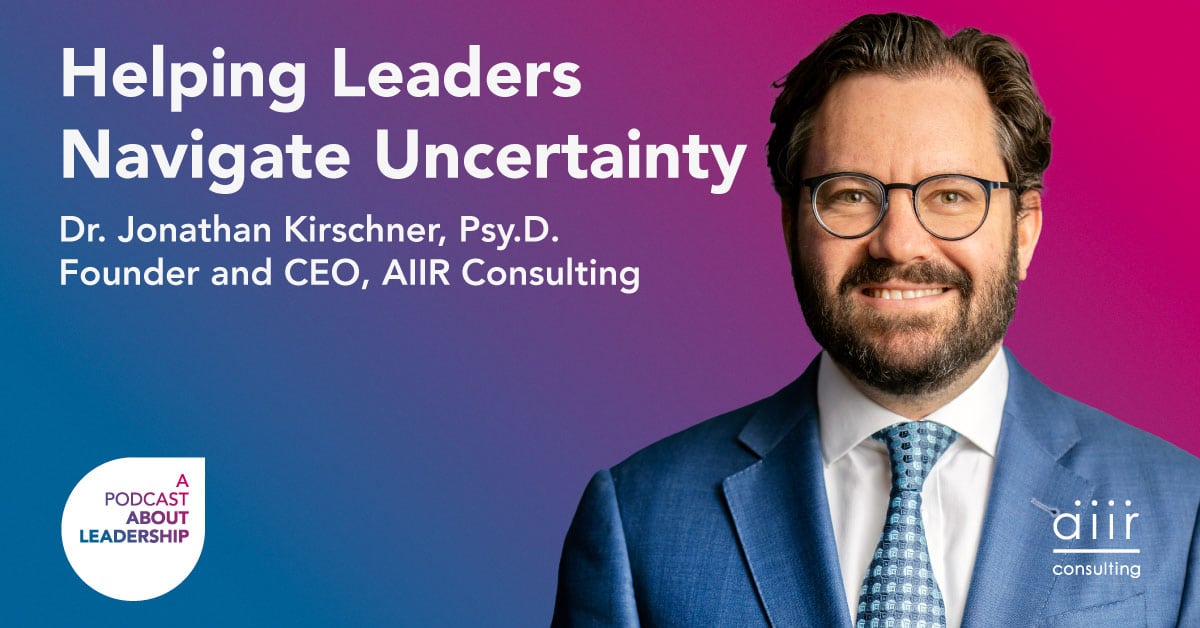
A Podcast About Leadership: Helping Leaders Navigate Uncertainty with Dr. Jonathan Kirschner

How Can Leaders Thrive in an Era of Relentless Change?
Leadership has never been a simple undertaking. It demands the ability to craft and communicate a clear vision, mobilize others to act, and sustain execution over time. Yet the demands of the role in 2025 are more complex, and more unforgiving, than at any point in recent history.
In this episode of A Podcast About Leadership, AIIR founder and CEO Dr. Jonathan Kirschner examines the enduring challenges of leadership and offers a framework for leading effectively amid the unprecedented convergence of political, social, economic, and technological disruption.
Leadership Has Always Been Hard — But the Game Has Changed
Historically, leaders could define a compelling vision, map multi-year strategies, and execute toward incremental milestones. While unexpected challenges inevitably arose, the pace of change was comparatively stable.
Today, however, leaders operate in an environment characterized by:
- Persistent socio-political volatility — rising polarization and global unrest
- Economic contradictions — markets, labor, and supply chains shifting in conflicting directions
- Technological acceleration — AI’s rapid evolution compressing innovation cycles from years to months, even days
Jonathan likens this shift to moving from a game of checkers to “four-dimensional human chess — with robots.” The sheer number of inputs and the speed at which they arrive demand a fundamentally different approach to leadership.
Three Imperatives for Leading in Turbulent Times
Jonathan identifies three core imperatives that allow leaders to meet today’s heightened demands.
1. Invest in Self as a Strategic Asset
In conditions of sustained volatility, personal resilience is not optional — it is foundational. Leaders who fail to manage their own energy and well-being risk cascading burnout throughout their organizations.
- Treat physical, emotional, and cognitive capacity as critical infrastructure.
- Establish and protect restorative practices, from structured exercise to reflective hobbies.
- Model sustainable performance habits to signal their importance to others.
2. Preserve White Space for Strategic Thinking
High-change environments create a bias toward constant activity. The danger: leaders can become trapped in the business at the expense of working on the business.
- Block uninterrupted time for reflection, scenario planning, and strategic dialogue.
- Engage boards, peers, or executive coaches to provide external perspective.
- Recognize that in complexity, decision quality, not activity volume, drives long-term outcomes.
3. Exercise Courage as a Core Leadership Attribute
Some leadership capabilities, like strategic thinking, can be taught and measured. Attributes such as courage require deeper, sustained development.
- Confront decisions that are uncomfortable but necessary.
- Pursue actions aligned with long-term vision even when they defy precedent.
- Challenge organizational inertia and personal comfort zones to position the enterprise for the future.
The Path Forward
The current leadership context is not a temporary spike in difficulty, it is the new baseline. Leaders must assume that volatility, uncertainty, complexity, and ambiguity (VUCA) will remain persistent features of the landscape.
Thriving in this reality demands leaders who are deliberate in self-management, disciplined in strategic thought, and courageous in action. These are not simply desirable traits, they are the non-negotiable capacities that will define successful leadership in the decade ahead.
About The Authors