
Adaptive Leadership: A Framework for Leading When Expertise Isn’t Enough

In the early 2000s, I moved to Seattle for my first headquarters leadership role at Microsoft. GPS technology was relatively new then, and a friend suggested I get one for my wife, who was home with our two-year-old daughter. It transformed her experience of our new city. Suddenly, she could explore unfamiliar territory without the anxiety of getting lost. The GPS gave her freedom through certainty.
Two decades later, that same technology has made us all passive navigators. We follow the blue line and trust the voice to reroute us. It works brilliantly, when there’s a map.
But there is no map for what senior leaders are navigating now. The challenges you’re facing can’t be solved by following directions. They require something different: helping people across your organization learn to read the terrain themselves.
Adaptive Challenges: When There Is No Map
Ron Heifetz called these adaptive challenges — problems that can’t be solved by expertise alone, but require people to change how they think, work, and lead. He distinguished them from “technical problems,” which experts can solve with existing knowledge and procedures.
Since Heifetz first wrote about Adaptive Leadership, the ratio of adaptive to technical challenges has flipped. What used to be occasional now feels constant. Organizations function as complex adaptive systems — environments where small changes can produce unpredictable, nonlinear outcomes and where the interdependencies between teams, markets, and technologies make it impossible to anticipate the consequences of any single decision.
As a result, there has been an explosion in academic research in this area for the last few years. Peer-reviewed publications on adaptive and agile leadership grew from just six articles in 2014 to hundreds annually by 2024. Adaptive leadership has moved from a niche academic concept to a front-burner organizational capability.
A Perfect Storm of Forces at Work
In my work with senior leaders across industries, I see three forces colliding to create this urgency.
- Geopolitical and economic fragility has exposed how brittle our operating assumptions have become. Supply chains, regulatory environments, and operational structures that leaders counted on for years now carry compounding, unpredictable risk.
- Digital transformation is moving faster than organizations can absorb it. McKinsey reports that 89 percent of large companies globally have a digital and AI transformation underway, yet they’ve captured only 31 percent of expected revenue lift and 25 percent of expected cost savings. Most of that shortfall comes down to people, not platforms—the behaviors, assumptions, and ways of working that new technology demands but can’t instill.
- Post-pandemic shifts have permanently altered the social contract between organizations and employees. Six in ten remote-capable employees now expect hybrid work arrangements, while Gallup reports that employee engagement globally has fallen to 21 percent, matching its lowest point during COVID-19 lockdowns. No amount of policy revision addresses what’s actually changed: people’s fundamental expectations about how work fits into their lives.
The confluence of these three forces is creating what the World Economic Forum’s Global Risks Report has termed a “polycrisis” — multiple systemic crises intersecting and amplifying their collective impact beyond what any single disruption would produce. For leaders, this means nearly every significant challenge now has adaptive dimensions.
From VUCA to BANI: The Human Cost of Complexity
The US Army War College coined VUCA in the 1980s — volatile, uncertain, complex, ambiguous—to describe the post-Cold War world. It became a staple of leadership language for decades. But in 2020, futurist Jamais Cascio argued that VUCA no longer captures what people and organizations are actually experiencing. He proposed BANI: Brittle, Anxious, Nonlinear, Incomprehensible. Where VUCA describes external conditions, BANI describes what those conditions do to us — systems that shatter under pressure, pervasive anxiety that clouds judgment, outcomes that defy prediction, and complexity that overwhelms our ability to make sense of what’s happening.
Heifetz anticipated this nearly three decades earlier. In their 1997 Harvard Business Review article, Heifetz and Donald Laurie observed that adaptive work creates distress, anxiety, confusion, and disorientation, and that leaders must attend to the emotional toll on people navigating that uncertainty. BANI gave new language to what Heifetz already understood: the hardest part of leading through complexity is managing what it does to people. His framework was forward-looking in ways the current environment has validated.
A Streamlined Model of Adaptive Leadership
Most senior leaders default to the approach that built their careers: diagnose quickly, decide decisively, drive execution. That works for technical problems. It backfires with adaptive challenges, because you can’t solve them for people. They have to do the work themselves.
I’ve taught Heifetz’s Adaptive Leadership model to senior leaders for years, and it’s brilliant. But the original six-principle framework can feel unwieldy in real time. I’ve distilled it into three core movements that senior leaders can actually hold in their heads during a crisis, a transformation, or a Tuesday afternoon leadership team meeting.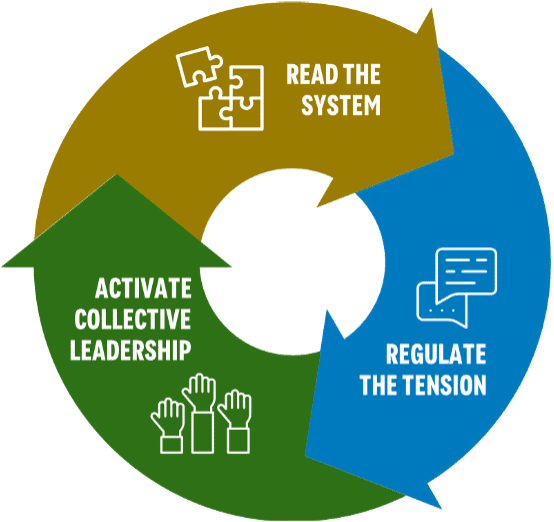
Step 1: Read the System Gain perspective and diagnose whether you’re facing a technical problem or an adaptive challenge that requires fundamental change.
Step 2: Regulate the Tension Calibrate stress levels to keep people engaged but not overwhelmed while ensuring attention remains on the critical issues.
Step 3: Activate Collective Leadership Mobilize people to take ownership of solving their own challenges while protecting those who speak difficult truths.
While the three “steps” imply a linear sequence, in practice, they operate simultaneously and recursively — you’re constantly reading the system while regulating tension and activating others. But naming them as three distinct movements gives leaders a compass when they’re in the middle of the work.
Step 1: Read the System
Before you can lead adaptively, you need to diagnose what you’re actually facing. This means moving between the big picture and the ground-level experience to see patterns, emotions, and dynamics you can’t detect from either vantage point alone.
Move Between the Balcony and Dance Floor
Heifetz uses this metaphor deliberately, and the key word is between. A senior VP I worked with was six months into a major acquisition integration. Her leadership team was meeting weekly to resolve what they called “alignment issues”—duplicated roles, conflicting approval processes, unclear decision rights. On the dance floor, it looked structural: consolidate the org chart, clarify who approves what, move on. From the balcony, she started to see a pattern: every “alignment issue” mapped back to the same underlying tension. The two organizations had fundamentally different beliefs about how decisions should be made. One operated through consensus—extensive consultation, broad buy-in, deliberate pace. The other valued speed and individual authority—leaders were expected to make calls and move.
Listen for What Is Not Being Said
It was back on the dance floor where she saw what that tension actually did to people. In one integration meeting, she watched a leader from the acquired company go quiet after being overruled in thirty seconds on a decision his old organization would have discussed for a week. He didn’t push back. He just disengaged. She started noticing that the leaders who had stopped contributing in meetings were almost exclusively from the consensus-driven culture, and their silence was being read as agreement.
Diagnose the Challenge
Redesigning the org chart and clarifying approval workflows? Technical — a good integration team can do that. But two organizations with deeply held, conflicting beliefs about how leaders should lead? Adaptive. Neither side was wrong. Both approaches had built successful companies. But people on each side experienced the other’s way of working as a threat to their professional identity, not just an inconvenience. Choosing one model wouldn’t work; the losing side would comply on paper and resist in practice. The real work was helping leaders across both organizations examine assumptions they’d never had to question, and that work didn’t belong to any single team or function.
Step 2: Regulate the Tension
Adaptive work creates discomfort. People have to let go of familiar ways of working, question long-held assumptions, and operate in ambiguity. Your job is to keep that discomfort at a productive level.
Modulate the Heat
A chief medical officer I worked with was leading her health system’s transition to a team-based care model where nurses, physician assistants, and care coordinators would share clinical decision-making authority previously held by physicians alone. Early on, the heat was too low. Physicians treated it as a staffing reorganization that wouldn’t affect how they practiced. Most ignored the new care team protocols entirely. She turned up the heat by sharing patient outcome data from their own system, showing that units already practicing team-based care had measurably lower readmission rates and higher patient satisfaction scores. The data was hard to dismiss because it came from their own colleagues down the hall.
Within a few months, the heat climbed too high. Senior physicians began openly refusing to participate in team rounds, arguing that clinical authority shouldn’t be shared with non-physicians. Two threatened to take their practices to a competing system. Department chairs who privately supported the change went quiet, unwilling to confront colleagues they’d worked alongside for twenty years. She created a physician advisory council that gave resisters a structured voice in shaping the implementation and temporarily slowed the rollout in the most contentious departments.
Direct Attention to the Tough Issues
Throughout the transition, her leadership team kept drifting toward safe topics — scheduling templates, updated job descriptions, revised rounding protocols. She kept redirecting them to what no one wanted to name: the system’s entire reward structure — compensation, promotion criteria, peer recognition, even how grand rounds were organized — still reinforced individual physician achievement. Every incentive was working against the collaboration the new model required, and untangling that meant questioning assumptions upon which most people had built their careers.
Set the Pace
Rather than rolling out the new model system-wide, she sequenced the work. She started with two units that had willing physician champions, gave them six months to pilot and learn, then used their results — including their mistakes — to shape the next wave. Each phase built credibility for the next one. Instead of being convinced through persuasion, the physicians who came around were convinced by watching their peers make it work.
Step 3: Activate Collective Leadership
You can’t solve adaptive challenges for people. Your job is to create the conditions for them to do the work themselves.
Give the Work Back
The president of a mid-sized liberal arts college I advised was facing a crisis that had been building for years: enrollment in traditional humanities programs was declining sharply, the board was pressing for career-relevant programming, and faculty saw any restructuring as an existential threat to the institution’s identity. Her instinct was to commission a task force, hire consultants, and present a plan. Instead, she told her academic deans: “This is your work. I can set the direction and hold the boundary, but I’m not going to design your curricula for you. The faculty have to own what comes next.” The deans wanted her to make the hard calls so they wouldn’t have to navigate the politics within their own departments. She held the line.
Protect Voices from Below
In one faculty senate meeting, a junior professor proposed an interdisciplinary program blending philosophy and data ethics, a combination that had strong student demand and obvious career relevance. Two senior faculty members dismissed it as diluting the department’s rigor. The president stepped in: “I’d like to hear more about what students are telling you. What are they asking for that we’re not offering?” She later met privately with the junior professor to make sure the proposal stayed alive and connected her with a sympathetic department chair in computer science. The idea didn’t need presidential authority. It needed presidential protection.
Enable Productive Experiments
Rather than mandating a college-wide curriculum overhaul, she carved out funding for three pilot programs, each designed by faculty, each with a two-year runway and clear enrollment targets. One combined environmental science with public policy. Another paired creative writing with digital media. The third, the philosophy and data ethics program, became the most popular elective on campus within a year. The pilots gave faculty permission to try things without the stakes of a permanent commitment. And the results did something no amount of strategic argument could have done: they gave skeptical faculty a reason to reconsider.
Where to Start
The next time you’re facing a challenge that feels stuck, where resistance persists and your team keeps looking to you for answers, pause and ask yourself: Is this technical or adaptive?
If you’re an HR, talent, or learning leader, this work cuts both ways. You’re coaching business leaders through their adaptive challenges while facing your own — redefining what high potential means when traditional success predictors no longer hold, shifting HR from order-taker to strategic partner, building talent pipelines in a labor market that has fundamentally changed, and co-creating a new social contract when neither employers nor employees agree on the terms.
Adaptive work will never be easy. But these three steps make it more navigable. When there’s no GPS to follow, the ability to read terrain, manage discomfort, and distribute leadership becomes your most valuable skill set.
About The Authors