
The Leadership Agenda Is Changing, and the Data Shows How

The Leadership Agenda Is Changing, and the Data Shows How
Every executive coaching engagement built on the AIIR® Method begins with a question: what does this leader most need to develop right now? Across thousands of engagements, the answers tell a story about how leadership itself is changing.
In October, AIIR convened its Client Advisory Board — senior HR, talent and learning leaders from organizations across industries — to examine that story together. We analyzed data from AIIR’s executive coaching and leadership coaching engagements from 2024 to 2026, including 652 coaching requests, 3,790 development goals and 817 Business Impact Surveys, and asked board members a simple question: what do you make of it?
Three leadership development trends stood out for 2026. Influence has overtaken collaboration as the skill leaders most want to build. Capacity has become a development goal in its own right. And the demand for emotional intelligence is rising fastest at the very top of the organization.
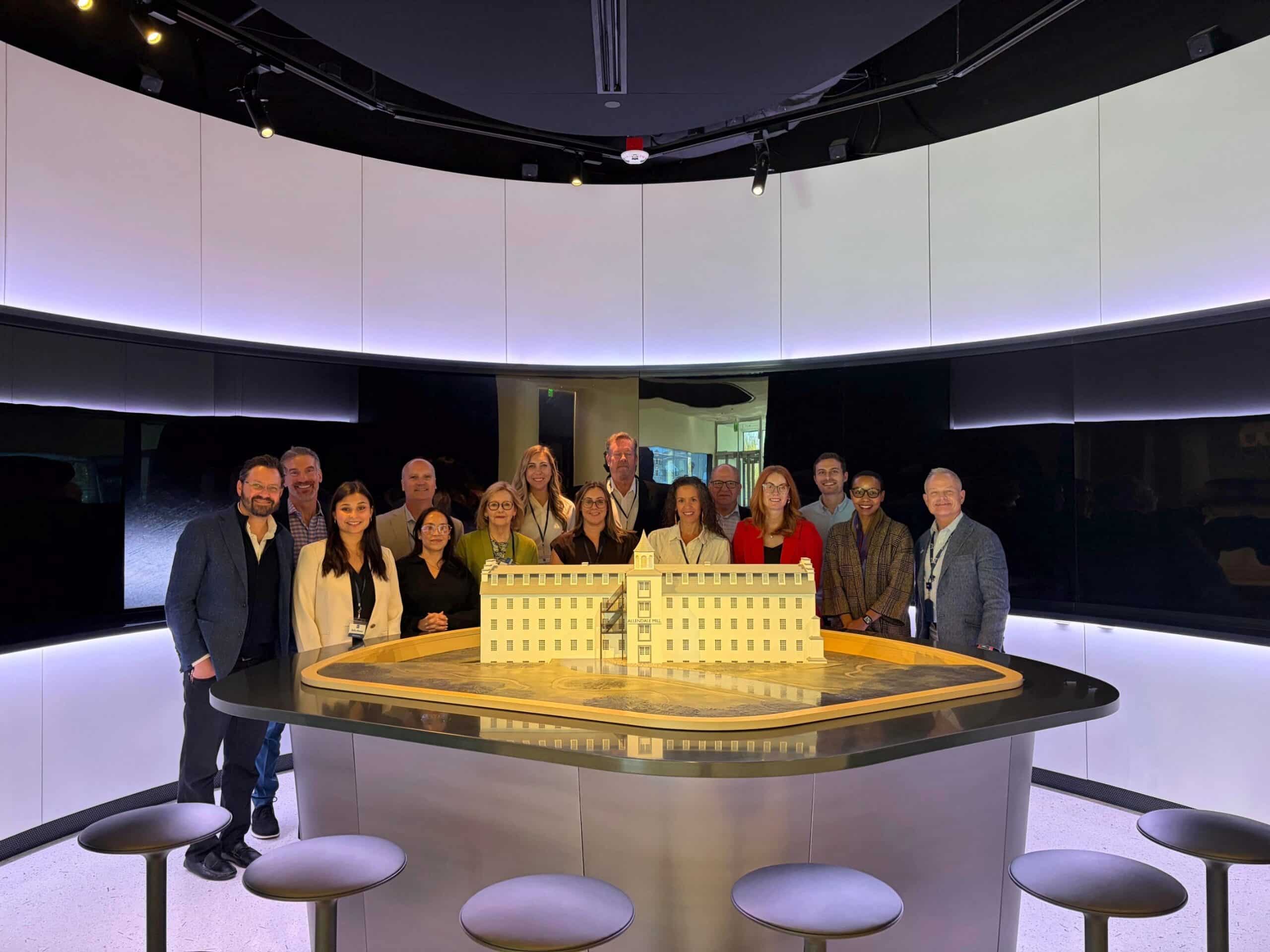 AIIR’s Client Advisory Board at FM Science and Technology Center in Norwood, MA
Shift 1: The Number One Ask Is Influence Without Authority
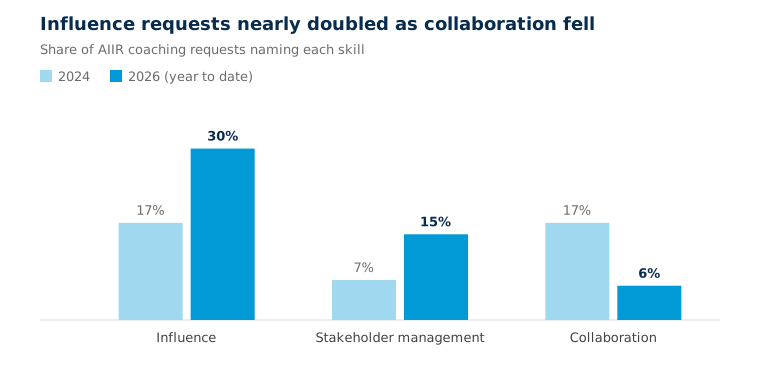
Influence without authority is now the most common development need named in AIIR coaching requests. It appears in 30% of requests in 2026, up from 17% in 2024, while requests focused on stakeholder management have doubled. Collaboration has moved sharply in the opposite direction, falling from 17% of requests to just 6%.
A typical request captures the shift in a single line: a leader looking to strengthen their ability to influence without authority and align senior cross-functional leaders around a shared vision.
Why Leading Without Authority Matters Now
Board members pointed to several forces reshaping how work gets done:
One board member offered a note of caution. Leaders may not be asking for collaboration, but that doesn’t mean they don’t need it. If influence is rising because work is harder to get done, collaboration is part of the answer. It raises a question every talent leader should consider: are we still promoting and developing leaders for a hierarchy that no longer exists?
Shift 2: Capacity Has Become a Development Goal
Leaders are increasingly coming to coaching not only to build new capabilities, but to expand their leadership capacity and manage how much they can carry. The share of coaching requests mentioning delegation, prioritization or capacity rose from 12% in 2024 to 29% in 2026. Development goals focused on delegation, boundaries and protecting time rose from 12% to 18%.
When leaders and their coaches set capacity-related goals, the most common focus is prioritizing and learning how to say no at work, followed closely by operating at the right altitude — the shift from executor to strategic leader.

The AI Paradox: Doing More, Accomplishing Less
For many board members, the finding was ironic. AI promised to expand capacity. Instead, the efficiencies it creates are often reinvested in more projects and more output, leaving leaders more stretched and carrying a heavier cognitive load than before. As one member put it, organizations are doing more but accomplishing less.
Three pressures came up again and again:
The human cost is real. Members described transformation anxiety, rising leadership burnout, leaders who have stopped taking care of themselves, and cultures drifting away from the care that once defined them. Others pointed to the hardest skill on the list: letting go. In science-driven organizations especially, the leader who conceived an idea often wants to see it through, which can make delegation feel like a loss.
Without strategic clarity, more capacity simply produces more activity. Leaders who can name what matters — and what doesn’t — give their teams permission to say no.
Shift 3: Leadership Is Requiring Heightened Emotional Intelligence, Most of All at the Top
Development goals focused on emotion regulation, reactivity, composure and self-doubt rose from 17% to 26% between 2024 and 2026. Among C-suite leaders, they now account for 34% of goals, the highest of any level.
Leaders’ own words reflect the shift. In their Business Impact Surveys, one leader described working with their coach to understand the tension points and improve their influence while managing the emotional response. Another reported that both their leadership and their stress had improved, after stress had been undermining many aspects of their work and relationships.
When Pressure Rises, the Shadow Side Emerges
To the board, this was the thread running through all three shifts. Constant transformation makes stress chronic, and chronic stress brings a leader’s shadow side to the surface more often. One member described a sharp rise in shadow-side behavior over just the past several months. Emotional intelligence in leadership also underpins influence itself: leaders who can’t take another person’s perspective can’t know what that person needs to hear.
It’s one reason the newest version of AIIR’s LD12 assessment now identifies seven shadow patterns — strengths that can derail leaders when overused or under pressure. The shadow is inevitable. Derailment is not.
Members shared how their organizations are building emotional intelligence into the way they develop leaders:
AIIR Founder and CEO Dr. Jonathan Kirschner noted that while much of emotional intelligence is cognitive, regulation is physiological. He shared the example of a CEO who placed exercise bikes at company headquarters to model self-care, and of a leader under intense pressure whose leadership reset after working with his coach on something as fundamental as breathing.
One board member added a final layer. Viktor Frankl argued that self-actualization isn’t the top of the pyramid; service to others is. Leaders today have more data than ever about their own sleep and steps, and almost none about their impact on the people around them. Helping leaders connect their work to a purpose beyond themselves may be one of the most powerful defenses against burnout.
What 100 Executive Coaches Are Seeing: Leading Through Change Tops the Agenda
To test the data against what’s happening in coaching sessions, we asked AIIR’s global network of executive coaches a single question: across your recent sessions, what are the one or two most pressing challenges leaders are bringing to coaching? Within 24 hours, about 100 coaches — roughly half the network — responded, drawing on their work with leaders from director level to the C-suite.

More than a third of responses centered on leading through change and uncertainty. Performance pressure, difficult conversations, trust and ethics, and accountability also surfaced frequently.
At first glance, the coaches’ top theme and the data’s top shift look different. In practice, they’re closely linked. When an organization’s structure is stable and predictable, collaboration and formal authority work well. When that structure is in constant flux, influence becomes the skill that gets things done.
The relatively low share for career growth also caught the board’s attention. Under this much pressure, leaders tend to push their own development down the list, even when their organization is investing in it. Members agreed that development must be a partnership: the organization provides the investment, and the leader has to make the time to claim it.
AI Transformation Is a People Challenge, Not Just a Technology Project
AI investment is accelerating, but measurable returns remain rare. Itamar Katsch, Managing Partner and leader of AIIR’s new AI Leadership Enablement practice, shared that only about 1 in 5 AI investments shows ROI, according to Gartner, and that an MIT study found 95% of AI pilots deliver no measurable impact. The gap, he argued, is rarely the technology. It’s adoption, enablement and AI change management: the operating model around the technology.
Employee sentiment is a significant part of the challenge. A 2026 survey from Writer and Workplace Intelligence found that 44% of Gen Z workers — and 29% of all employees — admit to sabotaging their company’s AI strategy. On Glassdoor, 53% of employee reviews that mention AI are now negative, up from 41% a year earlier. Board members recognized the pattern, from younger employees pushing back on AI rollouts to engagement survey comments questioning whether leadership cares about anything beyond cost savings.
Drawing on his experience leading company-wide AI upskilling as Global Head of Learning & OD at Similarweb, where AI adoption rose 43%, Itamar outlined an approach built around people:
His conclusion was clear: HR must own the AI transformation. Change, leadership and buy-in are HR’s core expertise, and AI now enables HR teams to build and pilot solutions that once required developers. Learn more about AIIR’s AI Leadership Accelerator and AI Leadership Forum.
A Lesson That Transfers to Every Organization
Taken together, the three shifts tell a single story. Leaders are being asked to move people they don’t control, in organizations that keep changing shape, with less time than ever. Meeting that challenge requires influence, strategic clarity and emotional steadiness — all at once.
For HR and talent leaders designing leadership development programs for 2027, the conversation surfaced five questions worth asking:
- Are we developing leaders for the organization we have today? Flatter structures reward influence and stakeholder management, but collaboration still matters, even when leaders aren’t asking for it.
- Are we helping leaders decide what not to do? Capacity challenges are often strategy challenges in disguise. Clear direction from the top is what gives people permission to say no.
- Do we reward how results are achieved? If emotional intelligence shows up in training but never in performance ratings or promotion decisions, leaders will conclude it’s optional.
- Is well-being built into leadership development? Regulation is physical as well as mental. Leaders who visibly model recovery give their teams permission to do the same.
- Are we building leaders who can think in systems? Leaders who succeeded for years in one environment often struggle when the system around them changes. What they need is the capacity to build new mental models, not to apply old ones harder.
Ready to Shape What Comes Next?
Want to learn how AIIR’s executive coaching and leadership development solutions help leaders build influence, capacity and emotional intelligence?
About The Authors